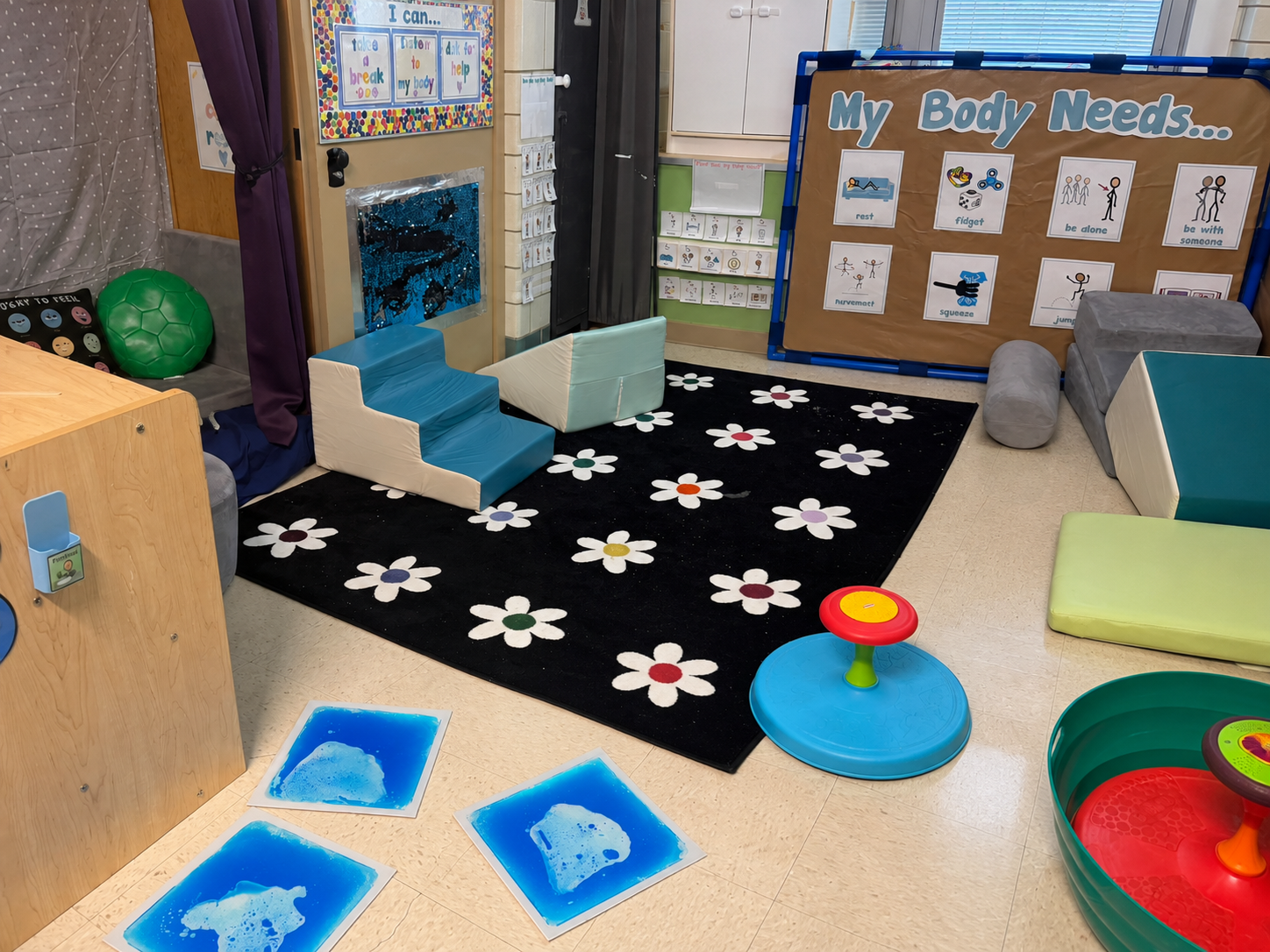
When I began teaching 20-something years ago, calm corners weren’t much of a thing yet. However, I quickly became aware of them and began making one in my own classroom. To me, it was a space for students to go and relax, take a break, and get themselves together before moving on.

As they have become more popular, they have also lost their uniqueness. I’m guilty of it too—especially when I was in the typical classroom—a kid gets upset, and you tell them to just go to the calm corner and calm down.
Somewhere along the way, we began to use it as an alternative to time-out and a space to just get kids out of the way.
However, in the past few years, I have learned so much more about what it means to be calm and what it means to be regulated! Calm can just be a surface behavior. It can be a student masking, holding it all in until they get home. They may look calm, but on the inside, there could be a tornado of emotions. I’ve felt this plenty of times as an adult, and I’m sure you have too!
Here’s the thing: regulation and calm are NOT THE SAME! We need to be regulated to learn…but not necessarily calm.
And regulation isn’t always about calming down.
Sometimes students need to move, rock, hum, chew, spin, click, take space, connect with someone, or simply have a different way to participate. Our brains are amazing, and many times, even while doing other things, we can still pay attention! But if we have to focus on making sure we aren’t moving, making noise, or looking in the right spot, we may not be able to pay attention.
This is why I decided my classroom needed a Regulation Station instead of a calm corner. We still have the Calm Cube, and there’s a quiet area in the Regulation Station because there are times students need these areas—but they should not be forced!


The Regulation Station Is Not a Calm Corner
One of the most important ideas behind the Regulation Station is that regulation can look different for every student.
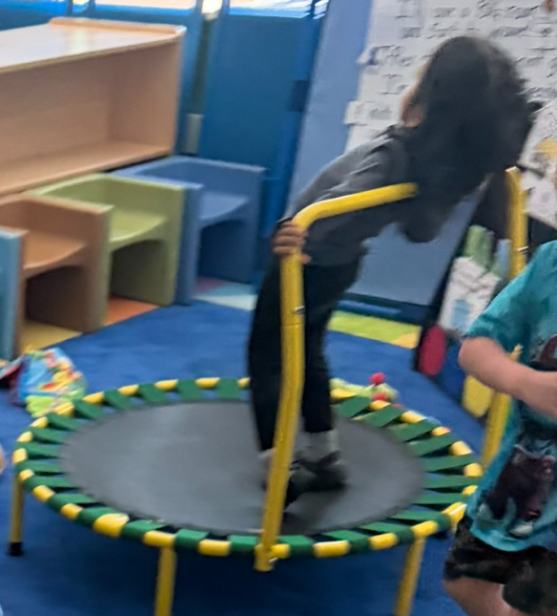
A regulated student may be sitting quietly—but they might also be moving, rocking, humming, fidgeting, spinning, chewing, standing, or using another form of sensory input that helps their body participate.
The Regulation Station is intentionally different from a traditional calm-down space. It isn’t a place students are sent when they are “too much.” It isn’t a consequence. And it’s definitely not a place where students have to sit quietly until they are calm enough to return to the classroom.
It should be used often and not only when a student is dysregulated. Instead, the Regulation Station can be part of everyday classroom life. Students can explore it when they are already feeling good. They can practice identifying body sensations, try different strategies, make choices, and discover what works for them before they actually need those strategies.
Then, when a difficult moment happens, they have already had opportunities to build that awareness.
Our goal shouldn’t be to make every student look calm. Instead, we can help students begin to notice:
- How does my body feel?
- What might I need?
- What could I try?
- Did that help?
These questions shift the focus from changing a student’s behavior to understanding and supporting the student.
Start With the Body
The Regulation Station begins with body awareness. Students may learn to notice things like:
- “My body feels wiggly.”
- “My heart feels fast.”
- “My muscles feel tight.”
- “My head feels busy.”
- “My body feels floaty.”

Of course, students don’t all experience or describe their bodies in the same way. Some students may use words. Others may point to a picture, use AAC, gesture, sign, make a sound, move toward or away from something, or communicate in another way.
From “What Do I Need?” to “What Can I Try?”
Once students begin noticing their bodies, we can help them explore what they might need. The Regulation Station separates this process into two important ideas:
- “I Think I Need…” — the broader need, such as movement, quiet, space, connection, or heavy work.
- “I Will Try…” — a specific activity or tool that is actually available to the student.
For example:
- I think I need movement → I will try jumping on the trampoline.
- I think I need quiet → I will try headphones.
- I think I need connection → I will try sitting with a trusted adult.
This gives students opportunities to move from simply identifying a feeling or need toward making a meaningful choice.
What If the Strategy Doesn’t Work?
It is okay if a strategy doesn’t work. Students aren’t getting a grade for choosing the “right” regulation strategy. The resource uses three simple responses:
- Yes
- Not Yet
- No
These aren’t grades. They’re information. Maybe jumping helped. Maybe headphones made things worse. Maybe a strategy worked yesterday but doesn’t feel right today. Maybe the student didn’t need a sensory strategy at all—maybe they needed water, food, rest, connection, space, help communicating, or a change in the environment. Instead of saying, “But this is supposed to help you,” we can say:
“That didn’t help. Let’s learn from that.”
A strategy that doesn’t work is not a failure. It is a discovery.
Students Are the Experts on Their Own Bodies
Adults bring experience, observation, and ideas. But students are the experts on their own experiences. Our job isn’t to decide: “You are doing this, so you must need this.” Instead, we can become curious.
- Notice.
- Wonder.
- Offer.
- Listen.
- Adjust.

A student rocking doesn’t automatically mean they need a particular sensory input. A student making noise doesn’t automatically mean they need headphones. A student moving doesn’t automatically mean they need to stop. Sometimes a behavior is already serving a purpose—and if it is safe and not causing harm, it may not need to change at all.
Regulation Can Be Part of the Whole School Day
The Regulation Station can be used during so many everyday classroom experiences. It might support a student:
- During arrival
- Before a transition
- During group time
- During centers
- Before an assembly or fire drill
- After recess
- During a challenging activity
- After something unexpected happens
- When the classroom becomes noisy
- When a student simply wants to explore a strategy that feels good
And sometimes the best regulation support isn’t a tool. It might be changing the environment, reducing a demand, offering more space, providing connection, allowing movement, or simply giving a student time.
Building a Personalized Toolbox
One of the most important parts of the Regulation Station is that it doesn’t assume the same strategies will work for everyone. Students can build their own personalized regulation toolbox by identifying:

- Strategies that help my body
- Strategies that don’t help my body
These preferences can change. A strategy that worked in September might not work in January. Something that didn’t work yesterday might be exactly what a student needs today. That’s okay. The toolbox can change right along with the student.
A Different Way to Think About Regulation
I created the Regulation Station because I wanted something that moved beyond the idea that students need to learn how to “calm down.”
I want students to have opportunities to understand their bodies, communicate their needs, make choices, and discover what helps them participate in their world. And I want teachers to have a practical framework for supporting that process without having to become a sensory detective or guess what every behavior means.
We aren’t looking for the strategy that makes a student “calm.” We’re helping students discover what helps their body.
Regulation is not a destination. It is a process of discovery.


Want to Create Your Own Regulation Station?
I’ve put all of these ideas together into my Regulation Station resource, which includes student visuals, body-feeling cards, “I Think I Need” and “I Will Try” cards, investigation activities, personalized regulation menus, teacher resources, safety considerations, communication and self-advocacy supports, and a full Teacher Manual & Implementation Guide.

It’s designed for preschool, special education, autism support, and inclusive classrooms and can be adapted to fit the students, materials, and spaces you already have.
You can find the Regulation Station in my Rivers of Learning store on Teachers Pay Teachers.
You can NOW find the Regulation Station in my very own store here!
Leave a Reply